2026 INCENTIVES TREND REPORT
How Program Managers are Maximizing Engagement and Optimizing Budgets
Unique insights to help you design the right incentive system for your specific goals and audience.
 EMERGING TREND: Successful senders either gave their recipients access to the Full Catalog, or offered no choice at all with only a Single Brand option. Meanwhile, Custom Selection took a nose-dive.
Don't worry if you don't know which brands your audience wants-they want to pick their own rewards, anyway. Give your recipients more autonomy by letting them choose their incentive from a large catalog.
Offer type |
2024 |
2025 |
Trend |
| Full Catalog | 29.9% | 41.4% | 38.6% |
| Single Brand | 35.9% | 34.4% | 3.9% |
| Custom Selection | 34.3% | 24.2% | 29.5% |
With a whopping 38.6% increase, offering Full Catalog is officially the Gold Standard for reward senders.
When to send Full Catalog? While always popular, Full Catalog is especially strategic for broader and/or global audiences, such as employee milestones, service awards, and long-term loyalty programs where personal preference is paramount.
While it saw a minor 3.9% decrease, the Single Brand category remains a core model for many reward senders. Brands like Starbucks, Amazon, and Visa® are excellent choices for focused single-option incentives.
When to send a Single Brand? This model is ideal for tactical campaigns, say for a coffee to reward webinar attendance, or any other moment where the action is specific and the reward should feel instant and simple.
While it still has its place, curating a specific list of brands is waning in popularity. The 29.5% decrease in Custom Selection highlights a significant shift in sending behavior.
When to use Custom Selection? This option remains a good strategy for campaigns with a dedicated theme. For example, if you're doing a dispersement to an underserved population, curated lists of gas and grocery gift cards work well.
EMERGING TREND: The incentive market is currently in a state of transition. Standard rewards have overtaken Promotional ones, meaning more senders are opting for non-expiring claim-by windows.
The best incentive programs now run on one of two engines, depending on their goals. Use always-on rewards for loyalty programs, and rewards with claim-by dates when you want to create a sense of urgency → and potentially optimize financially.
|
Reward Type Monthly average |
2024 | 2025 | Trend |
|
🌲 Standard |
52.9% | 58.2% | ↑10% |
|
⏱️ Promotional |
47.1% | 41.8% | ↓11.3 |
Let's look at the breakdown of Standard an Promotional by choice types:
| Choice Type | 2024 | 2025 | Trend |
| Full Choice | 35.8% | 50.9% | ↑42% |
| Single Brand | 25.5% | 24.7% | ↓3% |
| Custom Selection | 38.7% | 24.4% | ↓37% |
| Choice Type | 2024 | 2025 | Trend |
| Full Choice | 12.2% | 19.0% | ↑56% |
| Single Brand | 46.4% | 54.9% | ↑18% |
| Custom Selection | 41.5% | 26.2% | ↓37% |
And, just for curiosity's sake, let's look at reward types and their most popular use case and recipient behavior:
| Reward Type | Primary Use Case | Primary Choice Type | Recipient Behavior |
|
🌲 Standard |
Employee/Loyalty | Full Choice (50.89%) |
Deliberate: Higher consideration and claim times. |
|
⏱️ Promotional |
Consumer/Marketing | Single Brand (54.88%) |
Urgent: Rapid claim times for "instant" gratification. |
A trend we're seeing is the growth of evergreen reward programs. The total monthly average of Standard rewards sent grew by 10% year-over-year.
In 2025, Standard rewards accounted for 58.2% of all rewards sent.
Within the Full choice category, the shift to Standard was aggressive, moving up 42%. Nearly half of all Full Catalog rewards are now permanent fixtures in client programs.
With an 11.3% average monthly drop, Promotional rewards now power only 41.8% of all sends.
Promotional rewards remain the top pick for specific use cases like Consumer Incentives, where claim times actually became 28.6% faster in 2025. Senders rely on these for quick-turnaround marketing tactics that require swifter actions and for senders looking to claim breakage.
The 2025 data reveals a clear move toward recipient autonomy. In Standard programs, Full Choice has become the dominant strategy, now representing 50.9% of all rewards-a 42% year-over-year increase.
This trend extends to Promotional rewards as well. While Single Brand remains the volume leader at 54.9% (ideal for "coffee on us" style hits), Full Choice is the fastest-growing segment in this category, surging by 56% since 2024.
Across the board, clients are increasingly choosing to give their recipients total freedom of choice.
EMERGING TREND: For marketing and consumer incentives, recipients are moving faster, making the "reward loop" tighter and more efficient. However, recipients claiming relationship-based rewards (like employees and those receiving disbursement payouts) are taking more time to choose deliberately.
Claim-by dates for employees and disbursement recipients should be at least 15-30 days to accommodate their more strategic saving and spending habits. You might also consider switching to Standard rewards for these audiences.
Use Case |
2024 Avg Time (days) |
2025 Avg Time (days) |
Trend |
| Consumer Incentives | 9.5 | 6.8 | Faster ↓ 28.4% |
| Disbursements | 12.1 | 15.9 | Slower ↑ 31.4% |
| Employee Rewards | 7.4 | 8.7 | Slower ↑ 17.6% |
| Other | 12.6 | 10.4 | Faster ↓ 17.5% |
| Overall Average | 10.5 | 9.6 | Faster ↓ 8.6% |
Consumer Incentives saw the most significant shift in behavior with a 28.4% drop in claim time. Recipients went from taking an average of 9.5 days to just 6.8 days to claim their rewards.
Consumer-facing rewards (like for surveys, sign-ups, or purchases) are becoming more and more effective at driving immediate action. People want that "dopamine hit" faster in 2026.
Alternatively, employees are claiming their rewards 17.6% slower, stretching from 7.4 days to 8.7 days.
Remember that offering Full Catalog choice is surging by 38.6%. When employees receive a reward, they aren't rushing to spend it on the first thing they see. Instead, they act more like shoppers and take an extra day or two to browse and pick something they really want.
Disbursements/payouts (typically larger payments like financial aid or rebates) saw the largest increase in claim rate, up 31.4%. Recipient claim time here jumped from 12.1 days to 15.9 days.
Recipients may view disbursements more like traditional money and act accordingly. This 4-day jump in claim time suggests that people are being more strategic with these rewards, perhaps waiting for a specific bill to pay or a larger purchase to make, rather than treating it like pocket change.
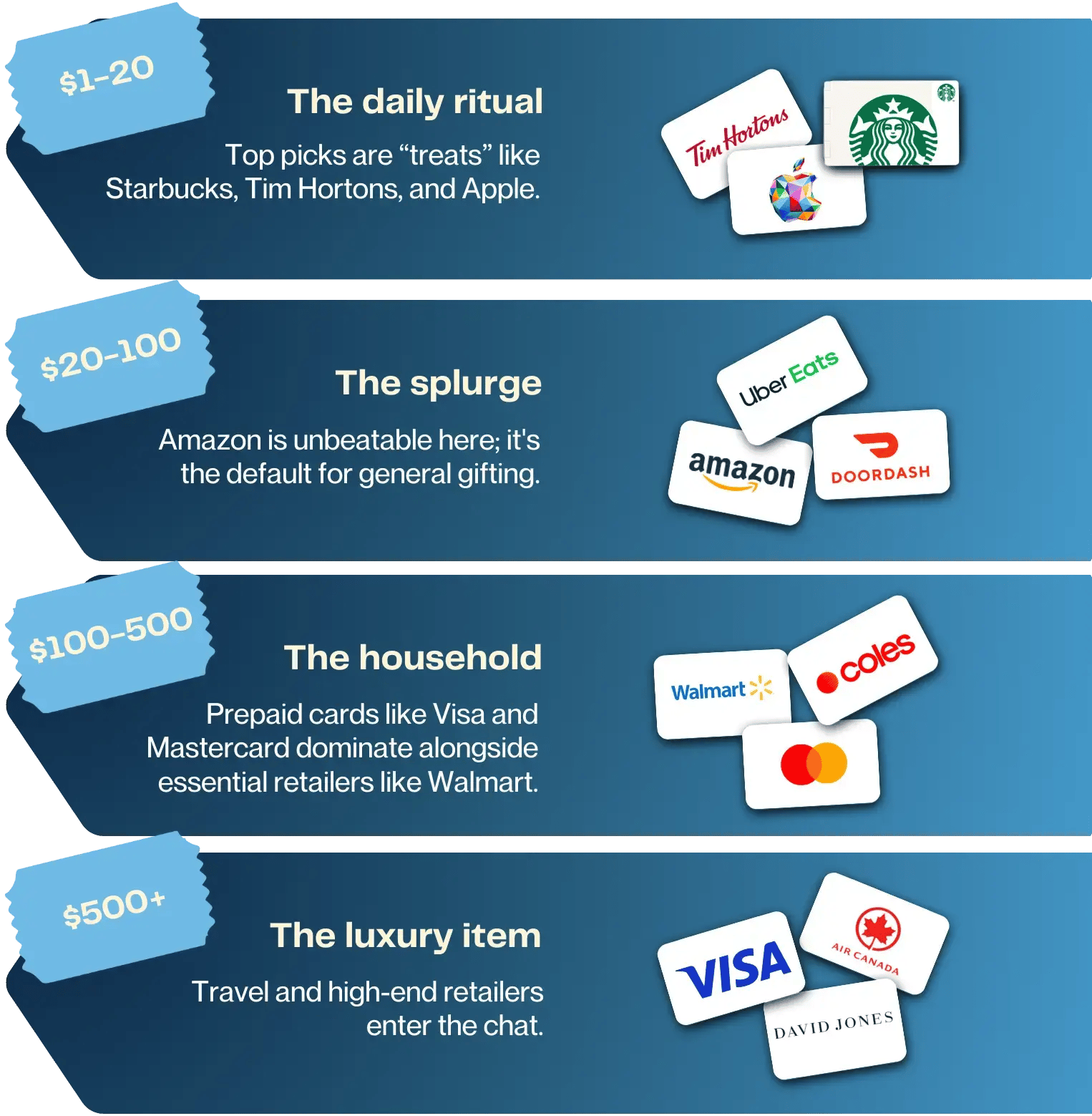
EMERGING TREND: The data shows a clear $100 threshold in brand popularity among recipients. Under $100, rewards are "fun money." Above it, and recipients shift to more practical and flexible options like Visa and Walmart.
Use the amount you're sending to help dictate what type of choice you give. A $50 Walmart card might not get your recipients very far; a $150 Walmart card lets them really stock-up. Conversely, a $150 Starbucks card might be "too much coffee," but $15 is a nice treat.
Giftbit clients send all over the world in many currencies, but for this report we narrowed the most popular brands down to three main currencies (USD, CAD and AUD):
| Price point | 🇺🇸 USD | 🇨🇦 CAD | 🇦🇺 AUD |
| $0-20 |
1. Amazon 2. Starbucks 3. Walmart |
1. Amazon 2. Starbucks 3. Tim Hortons |
1. Amazon 2. Apple 3. Kmart |
| $21-50 |
1. Amazon 2. Visa 3. DoorDash |
1. Amazon 2. Uber Eats 3. Walmart |
1. Amazon 2. Coles 3. Apple |
| $51-100 |
1. Amazon 2. Visa 3. Walmart |
1. Amazon 2. Visa 3. Uber |
1. Coles 2. Amazon 3. Playstation |
| $101-$500 |
1. Visa 2. Amazon 3. Walmart |
1. Amazon 2. Visa 3. Walmart |
1. JB Hi-Fi 2. Coles 3. Amazon |
| $501+ | Visa | Air Canada | David Jones |
Below $100, Amazon leads across USD, CAD, and AUD. The "utility shift" hits once a reward reaches $100+. Recipients across all regions opt for Visa and Mastercard or essential retailers like Walmart and Coles.
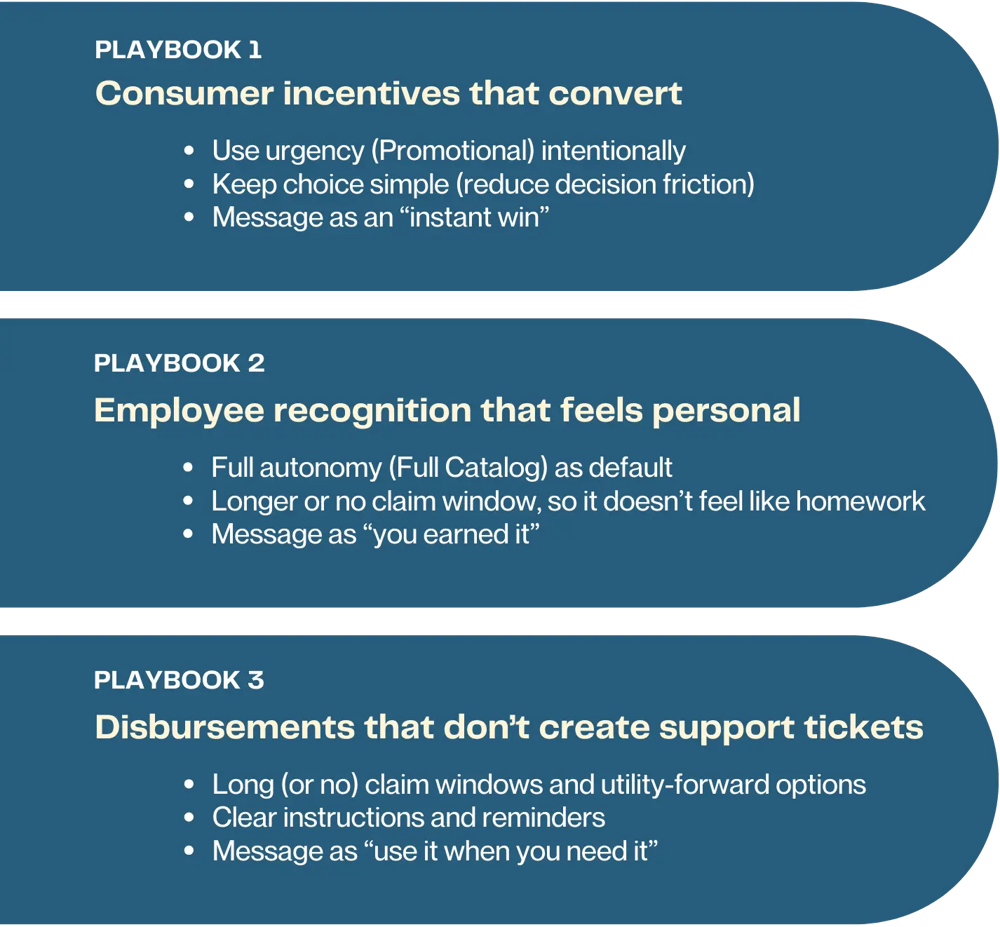
More and more, incentive programs are being designed around how people actually claim rewards. Some incentives are meant to be fast and lightweight, while others are meant to feel more considered.
When you match the right structure to the right audience, you get better engagement, fewer unclaimed rewards, and programs that scale without constant reinvention. The following recommendations will help you do that at scale.
Use the Full Catalog for programs meant to keep employees happy and engaged long-term, but stick to a Single Brand (like a $10 coffee card) for quick, small rewards.
Use Promotional rewards for marketing campaigns so you can reclaim unused funds and reinvest them, but use Standard (non-expiring) for milestones and loyalty to give people a permanent, no-pressure reward they feel they earned and can use whenever they want.
If you choose to send Promotional rewards — since customers claim rewards quickly (usually within a week) — use short deadlines to create urgency; however, give employees and disbursement recipients at least 15-30 days since they tend to take longer to claim.
If you're sending a single or curated list, focus on "treats" like Amazon or Starbucks under $100; for rewards over $100, stick to "utility" brands like Visa or Walmart. $500+ and they want luxury and travel.
The most successful reward programs this year will be those that respect the recipient's time and choice while utilizing the financial flexibility of the dual-engine model. By matching the right reward structure to the right audience behavior, senders can drive both immediate action and long-term brand affinity.